Benchmarks
These numbers exist to answer one question for teams evaluating H3 on .NET: what do you give up, and what do you gain, by binding the official Uber H3 C library instead of running a managed port?
Every measurement below is produced by the in-repo benchmark project with BenchmarkDotNet, comparing three implementations on identical inputs:
- Raw libh3 C: direct P/Invoke into the bundled native
libh3, no idiomatic layer. It is the floor: the fastest the C code can be called from .NET, and the baseline that isolates this binding's own marshalling overhead. - H3.NET.Native: this binding.
- pocketken.H3 4.0.0: the fully managed (NetTopologySuite-based) port, the managed library many teams run today.
Absolute timings vary by hardware; ratios are the stable signal. The runs shown
here are Apple M3 Pro, .NET 10, BenchmarkDotNet 0.15.8, DefaultJob, against Uber H3
v4.5.0.
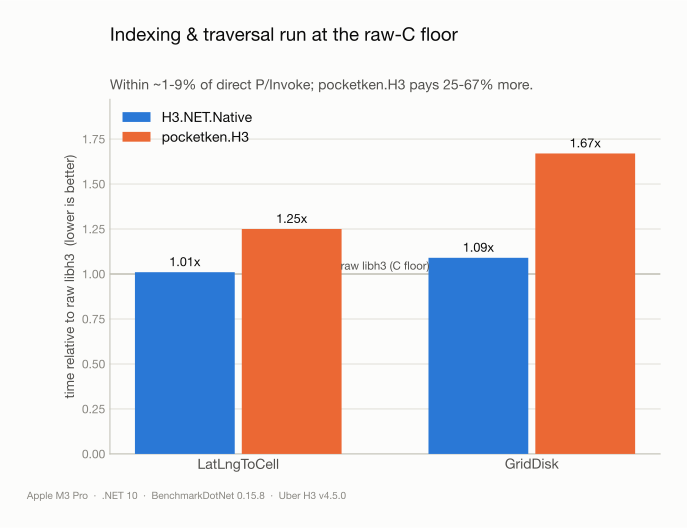
Indexing and grid traversal run at the raw-C floor
| Operation | Implementation | Mean | vs raw libh3 | Allocated |
|---|---|---|---|---|
latLngToCell |
raw libh3 | 195 ns | 1.00x | – |
latLngToCell |
H3.NET.Native | 196 ns | 1.01x | 0 B |
latLngToCell |
pocketken.H3 | 243 ns | 1.25x | 376 B |
gridDisk |
raw libh3 | 1,025 ns | 1.00x | – |
gridDisk |
H3.NET.Native | 1,115 ns | 1.09x | 1,504 B |
gridDisk |
pocketken.H3 | 1,709 ns | 1.67x | 6,576 B |
The binding adds 1–9% over calling the C directly (the cost of the safe, idiomatic, exception-mapped surface) and stays well ahead of the managed port, which pays 25–67% more and allocates on every call.
Batched hierarchy operations: cellToParent and cellToChildren
The hierarchy calls are the smallest unit of work in the library, so a fair comparison batches them. The harness takes 100 res-8 cells from a sorted San Francisco k=6 grid disk; they reduce to 19 unique res-7 parents and expand back out to 133 res-8 children.
| Operation | Implementation | Mean | Ratio | Allocated |
|---|---|---|---|---|
cellToParent (100 cells) |
H3.NET.Native | 275.5 ns | 1.00 | 0 B |
cellToParent (100 cells) |
pocketken.H3 | 301.5 ns | 1.09 | 2,400 B |
cellToChildren (19 parents) |
H3.NET.Native CellToChildren |
724.6 ns | 1.00 | 3,040 B |
cellToChildren (19 parents) |
H3.NET.Native CellToChildrenInto |
548.5 ns | 0.76 | 0 B |
cellToChildren (19 parents) |
pocketken.H3 | 1,030.4 ns | 1.42 | 5,016 B |
On cellToParent the binding leads on both axes: 275.5 ns against 301.5 ns for the 100
calls (about 2.76 ns per call, 1.09x faster), and zero managed allocation against
pocketken.H3's 2,400 B (24 B per call). The binding stays under 3 ns per call even though
every call goes through the LibraryImport source-generated marshalling stub and does
not yet apply SuppressGCTransition (deferred by design), so there is still headroom
below this number.
On cellToChildren the binding leads by more. Expanding the 19 parents to their res-8
children takes 724.6 ns returning a fresh H3Index[] (CellToChildren, 3,040 B), or
548.5 ns writing into a caller-supplied span (CellToChildrenInto, zero allocation),
against 1,030.4 ns and 5,016 B for pocketken.H3's GetChildrenForResolution. That is
1.4x faster allocating a new array, and 1.9x faster with zero allocation through the
span overload.
Filling polygons: polygonToCells
This is the one operation where a single headline number misleads. On a small polygon the native binding loses, but the reason is structural, and it inverts as the polygon grows.
Stable libh3 sizes its internal working buffer from the polygon's bounding box, not from the number of cells produced, and zeroes that buffer before filling. On a tiny polygon that fixed setup dominates, so a res-9, ~55-cell triangle looks like this:
| Polygon | Implementation | Mean | Ratio | Allocated |
|---|---|---|---|---|
| res-9 triangle (~55 cells) | H3.NET.Native | 98.8 µs | 1.00 | 608 B |
| res-9 triangle (~55 cells) | pocketken.H3 | 35.2 µs | 0.36 | 28,232 B |
But that fixed cost amortizes as the fill grows. Sweeping one fixed ~0.5° box over increasing resolution (so the output climbs from 1 cell to 156k) shows the real picture: pocketken.H3 wins on tiny outputs, the two cross at roughly 650 cells, and the native binding leads by ~1.4–1.6x from there on, while allocating ~19–46x less at every point.
| Resolution | Output cells | H3.NET.Native | pocketken.H3 | Faster | Native alloc | pocketken alloc |
|---|---|---|---|---|---|---|
| 4 | 1 | 9.3 µs | 1.9 µs | pocketken 4.9x | 192 B | 3.6 KB |
| 5 | 9 | 20.1 µs | 6.1 µs | pocketken 3.3x | 256 B | 7.6 KB |
| 6 | 65 | 46.0 µs | 29.4 µs | pocketken 1.6x | 704 B | 31 KB |
| 7 | 455 | 200.2 µs | 187.1 µs | pocketken 1.1x | 3.8 KB | 174 KB |
| 8 | 3,189 | 946.1 µs | 1,286.8 µs | native 1.4x | 25 KB | 1.1 MB |
| 9 | 22,334 | 6,150 µs | 9,842 µs | native 1.6x | 179 KB | 7.8 MB |
| 10 | 156,334 | 44,132 µs | 69,463 µs | native 1.6x | 1.2 MB | 57 MB |
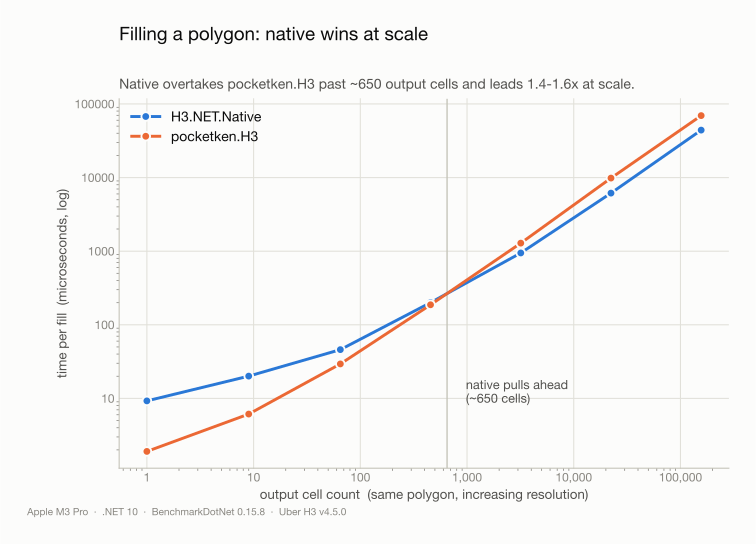
Most real region-fill workloads (covering a neighborhood, tile, or service area at a useful resolution) sit well above the crossover: the regime where the native binding is both faster and dramatically lighter on the GC.
Note: pocketken.H3 and libh3 do not always agree on the exact cells of a fill; the divergence is measured and quantified under Correctness and provenance below. The sweep above compares wall-clock on the same input, not cell-set equality.
The small-fill gap is the price of exactness
The crossover above has a structural cause, and it was measured directly rather than assumed. Stable libh3 finds cells by tracing the entire polygon boundary with cells and point-in-polygon testing every boundary cell plus its immediate neighbors, so its work scales with the perimeter measured in cells, not with the output size. Instrumenting a bit-identical reimplementation of the algorithm makes the imbalance concrete on the sweep box above: at res 4 the fill emits 1 cell but performs 43 point-in-polygon tests, at res 5 it emits 9 cells for 92 tests, and the ratio only falls toward 1 as area outgrows perimeter (1.4 tests per emitted cell by res 8).
Two prototypes were built to test whether that gap could be closed without giving up
exactness. A managed orchestration of the identical algorithm (calling the same native
primitives per cell, proven bit-identical to polygonToCells across every shape in the
divergence corpus plus 600 fuzzed polygons) sheds the native path's fixed setup and runs
19-32% faster than the binding on fills under a few tens of cells, but it stays 1.2-3.2x
behind pocketken.H3 below the crossover: the candidate work is inherent to the algorithm,
not to where it runs. The only approach that beat pocketken.H3 at every size was the one
pocketken itself uses, flood fill from a single interior seed, and even with an exact
point-in-polygon test it silently dropped cells on 6 of 30 fixed shapes and 3 of 600
fuzzed polygons (thin features, holes, and antimeridian-crossing shapes defeat single-seed
reachability).
As far as we can measure, beating pocketken.H3 on small fills and returning the reference
cell set are mutually exclusive. This binding keeps the reference cell set: neither
prototype ships in the package, and ToCells remains a thin call into libh3.
ToCellsExperimental for large fills
H3 v4.5.0 also ships an experimental polygonToCellsExperimental that honors every
containment mode; in center mode it targets the same containment predicate as stable
polygonToCells by a faster interior-fill algorithm. The binding exposes it as
H3Polygon.ToCellsExperimental(polygon, resolution, ContainmentMode.Center), gated
behind the [Experimental] attribute (diagnostic H3NET0001): upstream reserves the
right to change its behavior in any future minor H3 version, so it is an explicit
opt-in, never the default path.
On the same fixed ~0.5 degree sweep box used above, the two produce identical cell sets
at every resolution tested (4 through 8), a match the benchmark asserts in its
GlobalSetup. Where they differ is cost, and the sign of the difference flips with fill
size:
| Resolution | Output cells | Stable ToCells |
ToCellsExperimental |
Faster |
|---|---|---|---|---|
| 4 | 1 | 8.8 µs | 48.2 µs | stable 5.5x |
| 5 | 9 | 18.9 µs | 80.1 µs | stable 4.2x |
| 6 | 65 | 42.4 µs | 97.6 µs | stable 2.3x |
| 7 | 455 | 194.9 µs | 158.9 µs | experimental 1.2x |
| 8 | 3,189 | 917.1 µs | 330.9 µs | experimental 2.8x |
The experimental fill sheds the perimeter-tracing overhead that dominates small stable
fills, so it trails on tiny fills (up to 5.5x slower at res 4) and only pulls ahead once
the output passes a few hundred cells, crossing over between res 6 and res 7 and reaching
about 2.8x faster at res 8. Reach for ToCellsExperimental deliberately on large fills,
where that edge is real, and keep stable ToCells for everything else. Stable ToCells
remains the default and is not rerouted to the experimental path: the choice is the
caller's, not automatic dispatch.
Allocation
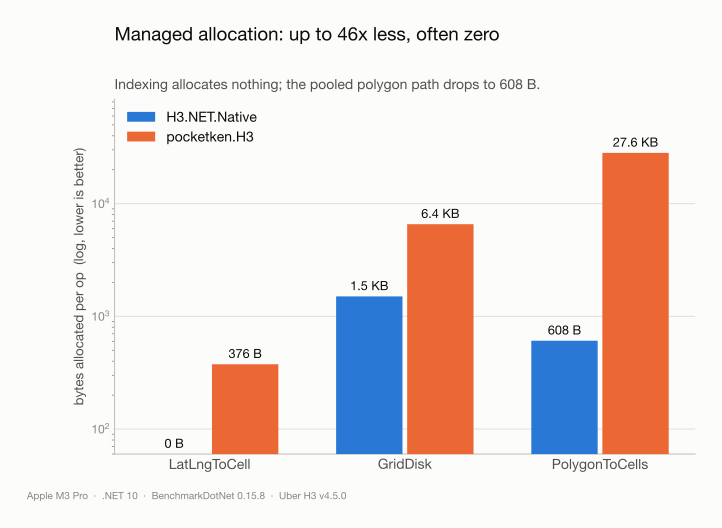
Managed allocation is where the native path wins universally: raw libh3 and the binding's indexing path allocate nothing, and the pooled polygon path drops to 608 B (down 25x from a prior naive buffer). pocketken.H3 allocates on every operation.
Correctness and provenance
Performance only matters if the results are right. Because the binding calls the
official Uber H3 C code directly rather than reimplementing it, its outputs are the
reference outputs. A differential test corpus, generated from the official library
via h3-py ≥ 4 (pinned to the bundled v4.5.0), with h3-go as a tiebreaker,
confirms the marshalling layer preserves them across every supported platform:
37,454 assertions at time of writing, zero tolerated failures. Cell and index
results match exactly; geometric measures (areas, lengths) match within a tight
floating-point tolerance that accounts for per-platform libm. A pure-C valgrind
harness guards native memory usage.
Polyfill divergence, measured
The fill-agreement caveat above is quantified, not assumed. A 27-case matrix, six
shapes (the benchmark triangle and sweep box, a concave L, a box with a hole, an
antimeridian-crossing quad, and a disjoint two-box multipolygon) swept across
resolutions 4–11, was filled by three implementations on identical inputs and
compared by SHA-256 of the sorted cell sets. The oracle is h3-py 4.5.0, whose
wheel bundles upstream libh3 4.5.0 exactly.
| Implementation | Identical to upstream | Mismatches |
|---|---|---|
| H3.NET.Native | 27 / 27 cases | none |
| pocketken.H3 4.0.0 | 20 / 27 cases | 7: every one a strict subset (cells missed, never added) |
The seven pocketken misses fall into two structural modes:
- Disjoint multipolygons are silently truncated. A single
Polyfill.Fillover an NTSMultiPolygonof two disjoint boxes returns only one component (12 of 23 cells at res 8; 564 of 1,128 at res 10): the fill flood-seeds from one interior point and expands only through grid-adjacent cells, so it can never reach the second component. Filling each polygon separately and unioning the results is correct and matched the oracle exactly. - Near-boundary cells are lost along slanted edges. On the res-9 benchmark triangle pocketken returns 51 cells to the oracle's 55 (at res 8, 1 of 7); every missing cell lies within one cell circumradius of a polygon edge. Its strict-interior point-in-polygon test over straight lines in lng/lat space rejects near-edge cell centers that libh3's containment convention includes. Axis-aligned shapes (the boxes, the concave L, the hole, even the antimeridian quad) matched the oracle exactly at every resolution.
The per-case counts, set hashes, and exact differing cell IDs, plus both
generators (the .NET harness that fills through this binding and pocketken.H3,
and the h3-py oracle script), are committed under tools/divergence-evidence/.
For supply-chain review, each release ships a CycloneDX SBOM and a signed build-provenance attestation, and is published to nuget.org via OIDC trusted publishing (no long-lived API keys).
Reproducing these numbers
Run the full suite (all categories, DefaultJob):
dotnet run --project tests/H3.NET.Native.Benchmarks -c Release -- --filter '*'
BenchmarkDotNet writes CSV and Markdown reports under
BenchmarkDotNet.Artifacts/results/. The charts on this page are regenerated from
those results by tools/gen-benchmark-charts/generate_charts.py (see its header for
the exact steps). Benchmarks are informational and never gate CI (a tiny dry-run
smoke runs there only to keep them building and runnable), and their shapes may
change while the binding is in preview.